
Hey there, lovely soul — welcome back to another Big Brew.
If you’ve ever felt like you’re running on fumes… waking up tired, powering through your day by sheer will, and going to bed with a buzzing mind instead of peace — I see you.
I’ve been hearing it everywhere lately — from the coworker who whispers she’s exhausted, to my friend who says she’s “just holding on,” and even a cashier at M&S who looked me in the eye and said, “I’m so tired.”
It’s not just you. It’s not just your season. Wrapped up in every one of us is a deep, quiet fatigue — not just of the body, but of mind, spirit, and connection.
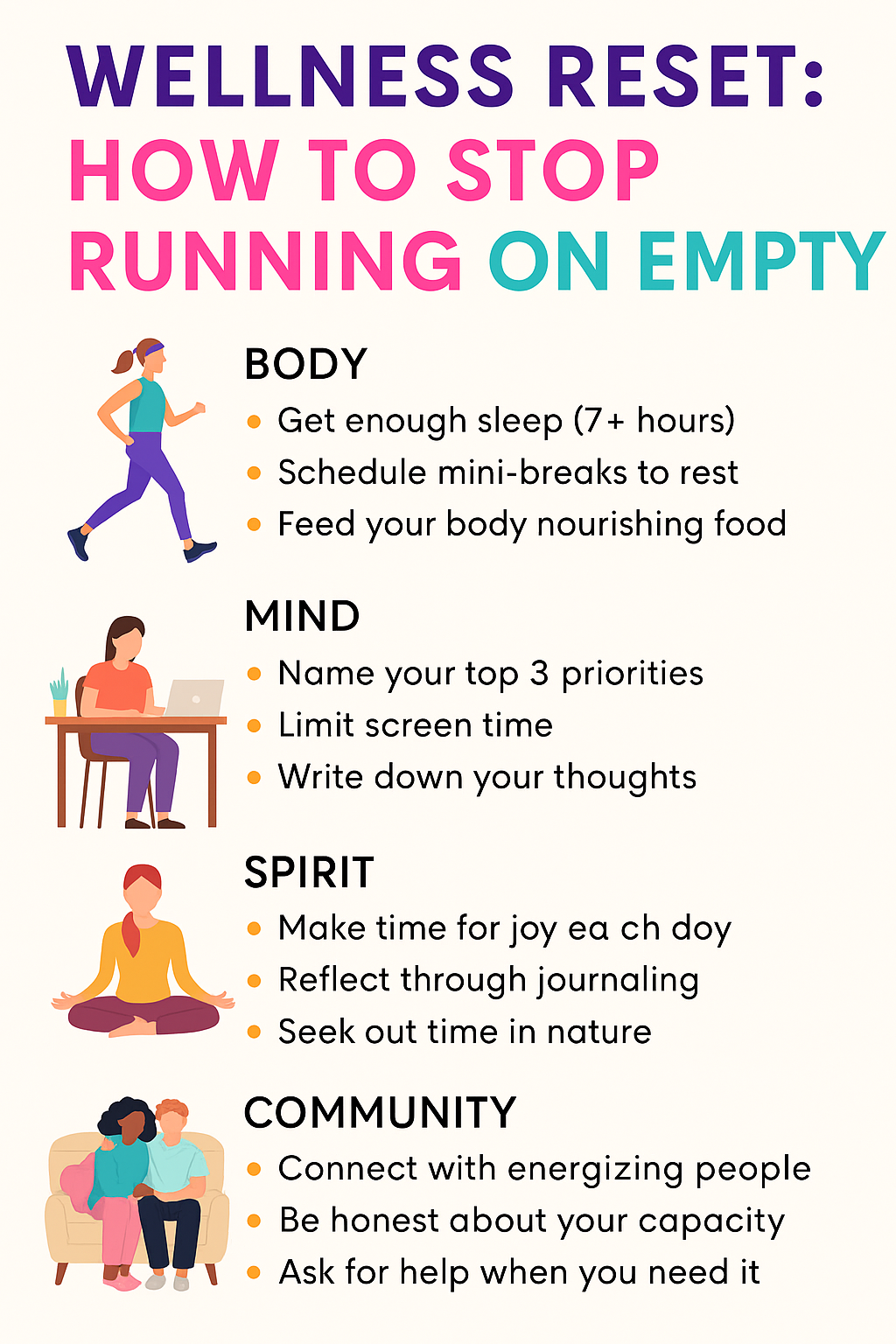
So in this Big Brew, I want to press pause with you. We’re going to reset. We’ll move through body, mind, spirit, community — name what’s draining you, refill the parts you’ve ignored, and build a simple, sustainable plan that actually fits your life.
This is your permission slip to rest. To reflect. To re-order your energy. And to begin again — gently.
What You’ll Get (Show Notes)
Here’s what we’ll do together in the session:
- Section 1: Check Your Tank — tune into how full (or empty) your energy really is
- Section 2: Body Brew — gentle, tiny swaps for sleep, movement, and nourishment
- Section 3: Mind Brew — release mental clutter and choose one reset habit
- Section 4: Spirit Brew — rediscover joy and give your soul small doses of what lights you up
- Section 5: Community Brew — map energy in relationships and craft one boundary
- Section 6: Design Your Energy Reset Plan — pull it all together into one ready-to-use framework
- Section 7: Affirmation Sip — create a mantra that anchors you through the weeks ahead
By the end, you’ll walk away with your own Energy Reset Plan — a booklet you can carry, a map you can follow, and a mantra you can whisper when things get messy.
Watch the Video Episode:
Show Resources:
- Download the free workbook that accompanies this episode (perfect for treating it like a workshop). Download the Workbook
- Book recommendation: “The Sleep Revolution” by Arianna Huffington — a compassionate guide to reclaiming rest in a world that glorifies exhaustion. It pairs perfectly with your Wellness Reset Plan, reminding us that sleep isn’t wasted time — it’s where healing begins. Get The Sleep Revolution
- Join coaching at nefeoguntoye.com/ for tailored support and accountability. Explore Coaching
- Subscribe on YouTube so you never miss a Big Brew or a Cappuccino & Confidence. Subscribe on YouTube
- Say hello on Instagram — share your #RoadMapLove ahas. @nefe86
- Join the weekly newsletter for a Tuesday tool or tiny habit nudge. Sign Up
Full Episode Transcript:
Big Brew 1 – Full Narration Script
Hello my loves, and welcome to Big Brew 1. I’m Nefe, your host, and today we’re doing something a little special — we’re going to design your Post-Summer Self-Love Roadmap.
I want you to imagine we’re sitting together at a cosy little café table, mugs in hand, just catching up. That’s the energy of today — not a lecture, not a class, but a gentle conversation we’re sharing over coffee.
Workbook Download
Now, if you’d like to join in fully, make sure you’ve got your copy of the workbook. You can download it right now from the link in the description below.
I’ll be working through the exercises with you, page by page, so you can follow along in real time. Think of this as a guided workshop — you and me side by side, pen to paper, taking the time to check in with ourselves.
Setting the Scene
This isn’t about doing everything perfectly or filling every single box. It’s about slowing down, reflecting, and finding small, meaningful habits that make life kinder and more sustainable.
By the end, you’ll have your very own Self-Love Roadmap — something simple, practical, and completely yours to carry into the next season.
Grounding the Why
Why are we doing this? Because life moves fast. We give our energy away so easily — to work, to other people, to endless lists. And if we’re not careful, we forget to refill our own cup.
This workbook, and this session, are about pressing pause. It’s about checking in with yourself, asking what you really need, and making small shifts that last.
Think of it as topping up your espresso shot for the season — strong, steady, and sustaining. The foam and sprinkles are lovely, but the espresso is what keeps you going.
What to Expect
Here’s how it’ll work today. We’re going to move section by section through the workbook, nice and steady. I’ll read out the prompts, we’ll pause so you can write, and I’ll share why each activity matters — so you’re not just filling in boxes, but really understanding the purpose behind them.
Think of it like a menu for our big brew:
- Section 1: Looking Back at Summer. We’ll reflect on the past season — the highlights, the hard bits, and the lessons — to see what we want to carry forward.
- Section 2: Self-Love vs Self-Care. Here, we’ll untangle the difference between comfort and true nourishment, and write our own personal definition of self-love.
- Section 3: Body. We’ll check in with our physical selves and choose one tiny, sustainable habit to support our health and energy.
- Section 4: Mind. We’ll clear out a little mental clutter and create a small habit to bring calm and focus into our days.
- Section 5: Spirit. We’ll reconnect with awe, joy, and meaning — the things that make life feel bigger than our to-do lists.
- Section 6: Community & Boundaries. We’ll look at the people around us, practise gratitude, and create kinder, clearer boundaries to protect our energy.
- Section 7: Your Self-Love Roadmap. Finally, we’ll pull it all together on one page — a practical, personal guide you can carry into the next 30 days.
By the end, you’ll have not just insights, but a full plan — simple, clear, and do-able — for building more love into your daily life.
Gentle Permission
And just before we dive in, I want to give you permission: take what you need, leave what you don’t. This is your journey. If something doesn’t resonate, skip it. If something really lands, linger there. There’s no rush — the only pace that matters is yours.
Alright, coffee topped up? Pen ready? Let’s brew some self-love together.
SECTION 1 — SUMMER DEBRIEF & ENERGY AUDIT
Right, let’s get started with Section 1: Summer Debrief and Energy Audit.
Why are we beginning here? Because reflection gives us awareness. If we don’t stop to look back at summer, we risk dragging the same stresses, the same habits, and the same patterns straight into autumn without even realising it.
Think of this like we’re coffee cuppers in a roastery. We’re not here to judge ourselves, or to pile on guilt. We’re just noticing. Some notes will be rich and smooth, some bitter, some surprising. It’s all information we can use. Ready?
1A — Roast Profile Questions
On your page, you’ll see the Roast Profile Questions. We’ll go through them together, one by one.
- First up: Rich & Chocolatey. When did you feel most alive this summer? Think of a moment where your energy felt high, your heart was open, and you felt really present. It might have been something big, like a holiday, or something small, like a morning walk or laughing with a mate. Write it down.
(pause 30–60s)
Why are we doing this? Because these moments are clues. They show us what genuinely nourishes us, so we can build more of it into the months ahead.
- Next: Burnt Espresso. Where did things feel heavy? Did you overcommit? Was there travel chaos, unfinished conversations, or just plain exhaustion? Jot those down.
(pause 30–60s)
And why note this? Because heaviness points to where boundaries are needed. By noticing it now, we give ourselves the chance to do things differently in autumn.
- Then we’ve got: Hidden Cinnamon. What lovely thing happened that you didn’t expect? Perhaps you discovered a new hobby, made a new friend, or had a happy surprise. Write that here.
(pause)
Why? Because these moments show us that life often gives us gifts when we’re open. They remind us to stay receptive, not just stick to rigid plans.
- Unpulled Shot. What did you want to do, but didn’t? Maybe you meant to send a pitch, visit the seaside, or simply rest more. Note it down.
(pause)
Why? Because unmet longings don’t just disappear. By naming them, we can decide whether to carry them forward intentionally, rather than letting them quietly slip away.
- Energy Highs. What activities left you buzzing with energy, ready to take on the world? Write them here.
(pause)
Why? Because energy is one of the truest guides we have. The things that lift you up are worth protecting.
- Energy Black Holes. What drained you in an instant — like your phone battery plummeting from 10% to 2%? Jot them down.
(pause)
Why? Because spotting the drains helps us plan smarter and conserve our energy for what really matters.
- Relationship Sweeteners. Who added richness and sweetness to your life this summer? Which relationships felt warm and supportive? Names, moments, feelings — pop them down.
(pause)
Why? Because gratitude helps us notice who belongs at our table, and it reminds us to invest back into those connections.
- Relationship Bitters. Who left an aftertaste? Maybe someone drained you, or there was a tricky interaction you’re still carrying. Note it here.
(pause)
Why? Because by being honest about this, even just on paper, we can see where boundaries might be needed.
- Risk Ratio. On a scale of 1 (decaf) to 10 (triple shot), how brave were you this summer? Write the number and what made you choose it.
(pause)
Why? Because courage grows through practice. Reflecting on where you stretched yourself — or where you stayed in your comfort zone — helps you be more intentional going forward.
- Lastly: Core Lesson. If Summer 2025 was a teacher, what one sentence would it write on the blackboard for you? Maybe it’s something like, “Rest is productive,” or, “Boundaries keep me free.” Whatever it is, let it come naturally.
(pause)
Why? Because turning a season into one clear lesson makes it stick. It’s the headline you’ll carry forward.
1B — Energy Coffee-Cake Slice
Next up is the Energy Coffee-Cake Slice.
Draw a circle and divide it into seven wedges: Work, Play, Body, Relationships, Rest, Growth, Finances. Shade in how much of your summer each one actually took.
Then outline how you’d like autumn to look.
If drawing’s not for you, use the table in the workbook and write percentages instead. Don’t overthink it — this is about awareness, not perfect math.
(pause)
Why are we doing this? Because how we spend our energy shows our true priorities — not just what we say we value. Sometimes we say we want more rest or play, but the chart shows work took 70%. This exercise makes the invisible visible, so you can realign before autumn takes over.
1C — Three Starred Insights
Finally, let’s pull out three insights from everything you’ve just written. Star three things that feel the most important.
(pause)
Why only three? Because less is more. Too much detail can be overwhelming. These three insights become your compass points for the rest of the workbook.
1D (Bonus) — Summer Roast Profile Prompts
And we’ve got one more page to finish Section 1 — a bonus reflection called the Summer Roast Profile.
- Tasting Notes. Write a few descriptive words that sum up your summer. Was it sweet, hectic, mellow, bittersweet? What did it feel like, sound like, taste like?
(pause)
Why? Because using sensory language locks memories in more deeply. It helps you connect emotionally to your reflection, not just list events.
- Process Variables. Note down what shaped your summer. Your routines, your habits, even the things you avoided.
(pause)
Why? Because process creates outcomes. If we want autumn to feel different, we need to adjust the process — not just hope for better results.
- Key Lessons. Write the biggest takeaways in a few lines.
(pause)
Why? Because when you name the lesson, you seal it. You’re far less likely to unconsciously repeat the same patterns again.
And that’s Section 1 done. You’ve created a rich roast profile of your summer — the highs, the lows, the surprises, and the lessons.
Why does this matter? Because self-love begins with awareness. You can’t shift what you don’t see. Now you’ve got clarity about what fuels you, what drains you, who adds sweetness, and what you’ve been avoiding.
This is the starting point for your roadmap. From here, everything else builds on what you’ve just uncovered.
SECTION 2 — SELF-LOVE VS SELF-CARE
Alright, now that we’ve looked back at summer and pulled out our insights, let’s shift gears.
Section 2 is all about something that gets mixed up all the time: self-love versus self-care.
Now, here’s the thing: they’re not the same. Think of a lovely cup of coffee. Self-care is like the latte art on top — it’s beautiful, it makes you smile, and it feels nice. But self-love? That’s the espresso shot underneath — strong, sustaining, and essential.
We need both. Foam makes it enjoyable, espresso makes it real. So in this section, we’re going to tease apart the difference, and see where your habits are nourishing you deeply, and where they’re just adding a bit of froth. Ready?
2A — Definitions Deep-Dive
On your page, you’ll see two columns.
On the left, write down self-care activities — the things you do to soothe, relax, or treat yourself. Maybe that’s having a bath, a skincare routine, buying yourself flowers, going to the gym, bingeing a Netflix series, or even having your favourite takeaway. Whatever counts as self-care for you, jot it down.
(pause while they write)
Remember, there’s no right or wrong here. Self-care can be anything from meditation to chocolate cake — this is just about noticing what you already do.
Now, in the right-hand column, write down self-love qualities or identities. These are things like:
- self-respect
- patience
- worthiness
- boundaries
- kindness towards yourself
- discipline
- courage
These aren’t activities — they’re deeper qualities of who you are when you’re truly rooted in self-love.
(pause)
The reason we’re doing this is because care and love aren’t always the same thing. A bubble bath can soothe you, but it won’t necessarily build your sense of worth. And setting boundaries might not feel cosy in the moment, but it’s a huge act of self-love.
Now, here’s the fun part: draw arrows from your self-care activities to the self-love qualities they genuinely support.
For example:
- Going to the gym → might connect to self-respect and discipline.
- Journalling → might connect to clarity and compassion.
- Skincare routine → might connect to self-worth.
But here’s the kicker: not every activity will have an arrow. That Netflix binge might not connect to anything — and that’s okay! It’s still nice foam. Foam is part of the coffee experience — it just doesn’t replace the espresso.
(pause while they connect arrows)
This little exercise is powerful because it helps you see where you’re genuinely nourishing yourself — and where you might be mistaking comfort for care. Both are fine, but knowing the difference is everything.
2B — Working Definition Statement
Now let’s make it personal.
The workbook asks you to finish two statements.
First: ‘Self-love, to me, means…’
Take a moment and write what comes up. Maybe it’s, ‘treating myself with respect,’ or ‘being patient with myself when I make mistakes.’ There’s no wrong answer — this is your definition.
(pause)
Why are we doing this? Because if you don’t define self-love for yourself, you’ll chase what Instagram or culture tells you it is. And that’s often just expensive self-care products. Defining it makes it real for you.
Now the second one: ‘When I neglect self-love, I usually…’
Maybe you overcommit, say yes when you mean no, get burnt out, speak harshly to yourself, or feel resentful. Whatever your personal signs are, write them down.
(pause)
‘Why? Because these are your warning lights. When these behaviours show up, you’ll know you’re running low on self-love, and it’s time to refill your cup.
Story Time – Sarah’s story
Before we wrap up this section, let me share a quick story with you, because I think it really shows the difference between self-care and self-love.
One of my coaching clients — let’s call her Sarah — came to me absolutely exhausted. She was doing all the ‘self-care’ things she thought she should: bubble baths, facemasks, even treating herself to a takeaway after long workdays. But underneath, she still felt drained, resentful, and on the edge of burnout.
Why? Because those things were comfort, not change. They soothed her in the moment, but they didn’t address the deeper issue — that she never said no at work, and her boundaries were paper-thin.
When we shifted her focus to self-love, things changed. Instead of another facemask, her act of love was saying: ‘I won’t answer emails after 6 p.m.’ Instead of a bubble bath, it was actually asking for help from her partner with the housework.
And do you know what? She still enjoyed her baths and Netflix nights — but because she had healthier boundaries underneath, those treats became genuine joy, not desperate recovery.
That’s the heart of this section. Self-care is lovely, but self-love is what keeps you standing. It’s the deeper action that says, ‘I am worth protecting, not just soothing.’
And that’s Section 2 complete.
You’ve just mapped out what care looks like, what love looks like, and how the two connect. You’ve defined self-love in your own words, and you’ve identified the signs you can watch for when it starts to slip.
Why does this matter? Because now you won’t confuse comfort with nourishment. You’ll know when you’re topping up your foam, and when you’re strengthening your espresso. Both are valuable — but espresso sustains you.
This clarity is going to make the next sections even more powerful, because you’ll be choosing habits not just for comfort, but for love.
SECTION 3 — PILLAR 1: BODY
Alright, let’s move into Section 3 — the first of our four pillars: Body.
Here’s why we start here: your body is like the espresso machine. If it’s not looked after, nothing else works properly. The coffee won’t flow, the shot won’t pull right, and the whole brew feels off.
But don’t panic — this isn’t about overhauling your diet or training for a marathon. It’s about noticing where your body is at, and then choosing one teeny, tiny habit to support it. Something so small it almost feels silly.
Because small is sustainable — and consistency is the purest form of self-love.
3A — Mini-Vitals Espresso
First, the workbook invites you to gather a bit of playful data — like a mini health check. These aren’t tests, they’re just little snapshots of how your body feels today. Think of it like checking the dials on the machine before you brew.
Here’s what we’ll try:
- Pulse. Place two fingers on your wrist or neck. Count your heartbeat for 30 seconds, then double the number. Jot it down.
(pause 20s)
Why do this? Because noticing your heart rate helps you tune in to how your body’s really doing. It can be a reminder to breathe, to slow down, or to celebrate your body ticking along.
- Sit-to-Stand. Time how long it takes you to sit down and stand up five times.
(pause 20s)
Why? Because mobility is freedom. Tracking something simple like this helps you see progress over time — and it makes you aware of strength and ease in your daily movement.
- Hydration Tint. The next time you go to the toilet, look at your wee (yes, we’re going there!). Is it latte, amber, or espresso-coloured? Write it down.
(pause, smiling)
Why? Because hydration is one of the simplest but most overlooked acts of self-care. This check is a playful nudge to drink more water if you need to. The clearer or latte coloured, it is, the more hydrated you are.
- Waist-to-Floor. Use a tape measure to see how many centimetres from your waist to the floor. Jot it down.
(pause)
Why? Because this is a quick way to notice proportions, posture, and body awareness. Again, no judgement — just data.
- One-Leg Balance. Stand on one leg with your eyes closed and see how long you last before wobbling. Write the number.
(pause)
Why? Because balance is linked to both brain and body health. It’s a fun reminder that tiny practices now protect your independence later in life.
Now, if you don’t want to do these checks right now, that’s completely fine.
The point isn’t the numbers — it’s the act of tuning in, of checking in with your machine. Sometimes we’re so in our heads that we forget to notice how our body actually feels.
3B — Choose One Body Habit
Now comes the most important bit of this section: choosing one body habit.
Here are your options from the workbook:
- Calf raises while brushing your teeth.
- Ten minutes of sunlight before screen-light.
- Protein-first plate — one palm-sized portion at each meal.
Take a look and pick one. Just one.
(pause while they choose)
Here’s why these work:
- Calf raises — build strength and circulation without needing extra time in your day. It’s habit-stacking — you’re already brushing your teeth, so you add a tiny boost.
- Sunlight before screens — resets your body clock, boosts your mood, and protects your sleep. It’s like reminding your body it’s morning before your phone tells you it’s chaos.
- Protein first — balances your blood sugar, keeps your energy stable, and reduces that afternoon crash.
Now, write it down in your workbook. Then complete the 7-Day Pledge: ‘I, [your name], will practise [your chosen habit] for seven consecutive mornings starting [date].’
(pause while they write)
Why a pledge? Because writing it down makes it a promise — not just a passing idea. And why just seven days? Because seven is doable. We’re proving to ourselves that we can stick with something tiny, and that builds trust.
And if you want, add a witness — a friend, partner, or even me here with you today. Saying it aloud or sharing it makes it more real.
(gentle filler)
Remember — keep it laughably easy. If it feels too small, that’s perfect. We’re not looking for dramatic change here. We’re looking for tiny, consistent love notes to your body.
And that’s your Body pillar sorted. You’ve checked in with your machine, and you’ve chosen one small act to keep it running smoothly.
Why does this matter? Because when your body feels looked after, everything else becomes easier — your mind is clearer, your spirit feels lighter, your relationships feel more grounded.
This pillar reminds you: your body isn’t a project to fix — it’s a partner to care for. And even the tiniest habit can be an act of love.
SECTION 4 — PILLAR 2: MIND
Alright, let’s pour into our second pillar: Mind.
Here’s why this one matters: your mind is like your kitchen countertop.
When it’s clear, you can cook with ease. When it’s cluttered with every pan and jar, even making a sandwich feels stressful.
This section is all about decluttering that mental countertop and then installing one small, nourishing habit to protect it. Nothing dramatic, just simple shifts that make your thoughts feel lighter.
4A — Two-Minute Brain Dump
“First up — the Two-Minute Brain Dump.
Grab your pen and, for the next couple of minutes, just pour everything that’s in your head onto paper. Big things, little things, random reminders, even thoughts like ‘I don’t know what to write’. Don’t edit yourself — just get it all out.
(give them a moment, encourage as they write)
Think of this as tipping out the junk drawer of your brain. You don’t have to sort it yet — you’re just emptying it so you can see what’s inside.
Once you’ve poured everything out, we’re going to tag each line with a letter:
- A for Action — something you can do quickly, in under two minutes.
- D for Delegate — something you can hand to someone else.
- S for Someday — something that matters, but not right now.
- R for Release — something you can let go of.
(pause while they tag items)
Why are we doing this? Because our brains are rubbish at holding lists.
When you write things down, your brain trusts it doesn’t have to keep spinning them. Labelling them stops you feeling like everything is urgent. Suddenly, you’ve got clarity instead of chaos.
4B — Select One Mind Habit
Now, let’s choose your one tiny mind habit.
The workbook gives you three lovely options:
- Box breathing — four slow counts in, hold for four, four counts out, hold again. Five minutes of that.
- Two-page bedtime read — literally two pages of a book before bed.
- Digital sunset at 9 p.m. — phone away, on charge somewhere else, so your brain can switch off.
Take a moment to choose which one feels both do-able and nourishing.
(pause)
Here’s why each works:
- Box breathing helps regulate your nervous system. It’s like pressing the reset button on stress.
- Bedtime reading helps you drift off calmly, and gives your brain something gentler than scrolling TikTok at midnight.
- A digital sunset helps your sleep, your mood, and your focus the next morning — because blue light and endless notifications keep your mind buzzing.
Whichever one you choose, anchor it to something that already happens. For example:
- ‘I’ll do box breathing while the kettle boils.’
- ‘I’ll read my pages once I’ve brushed my teeth.’
- ‘I’ll plug my phone in to charge when the clock hits nine.’
Write your habit down, and then add a sticky-bean cue word — just one small word you can put on a Post-it by your kettle, your book, or your charger. It’s a playful nudge that keeps the habit front of mind.
(pause while they write)
Why are we doing this? Because habits stick best when they’re tiny, anchored, and visible. We’re not trying to force discipline through sheer willpower. We’re gently reminding ourselves that our mental peace is worth protecting.
And that’s your Mind pillar complete.
You’ve cleared a little mental clutter with your brain dump, and you’ve chosen one small habit that will help keep your headspace lighter.
Why does this matter? Because your mind shapes how you experience everything else — your body, your spirit, your relationships. When your thoughts are calmer and clearer, life feels less like a frantic dash and more like a steady sip.
This pillar reminds you: protecting your peace is just as important as chasing your goals.
SECTION 5 — PILLAR 3: SPIRIT
Alright, let’s move into our third pillar: Spirit.
Now, this is a word that can mean all sorts of different things to different people. So don’t get hung up on definitions or what you should feel.
Here’s how I like to think of it: spirit is what makes life feel bigger than your to-do list. It’s that sense of awe you get when you stand under a huge sky, or listen to music that moves you, or pause long enough to realise you’re part of something much greater.
And why does this matter? Because without spirit, life becomes flat. It’s just tasks, deadlines, and going through the motions. Spirit adds depth, flavour, meaning. And the good news is, you don’t need hours of meditation to connect to it — tiny moments of awe are enough.
5A — Ten-Second Definition
Let’s start simple. Finish the sentence in your workbook:
‘Spirit feels like…’
Take ten seconds and just write what comes up. It could be peace, stillness, joy, connection, wonder, freedom — anything that resonates with you.
(pause 20–30s while they write)
Why do this? Because spirit is personal. If you don’t name what it feels like for you, it stays vague. And when something is vague, it’s harder to cultivate. Once you name it, you know what to look for.
So you know, for me, spirit feels like joy — those little sparks of happiness that remind me I’m alive.
5B — Choose One Spirit Habit
Now we’re going to choose one small spirit habit — something tiny that helps you connect to that sense of awe.
Here are the options in your workbook:
- Sunrise sensory awe. Head outside and experience the sunrise with no headphones, no distractions. Just let the colours, sounds, and air remind you of your place in the bigger picture.
- Creative froth doodle. Fifteen minutes of playful creativity — drawing, doodling, painting, colouring, writing poems — not for productivity, just for fun.
- Sixty-second stillness between tasks. Before moving from one task to another, take one slow minute to pause, breathe, and notice.
Pick one that feels do-able for you right now.
(pause while they choose and write)
Why these? Because they’re quick, simple doorways into awe. Sunrise resets your body clock and gives you perspective. Creative play reconnects you with joy and curiosity. Stillness slows you down and turns ordinary transitions into sacred pauses.
Notice that none of these take hours — we’re talking one minute, or a quarter of an hour at most. Spirit doesn’t need to be dramatic. Tiny drops are enough to flavour your whole day.
Now, in your workbook, write down when and where you’ll practise it. Maybe it’s sunrise on Saturdays, doodling before dinner, or a stillness minute between closing your laptop and starting tea. Add a start date too.
If you like, colour it in gold —as a reminder that this is precious.
5C — Visualisation Notes
Before we wrap up this section, there’s a little guided visualisation.
Here’s how it works:
- Close your eyes for a moment.
- Imagine inhaling the smell of freshly ground coffee. Really let yourself smell it.
- Now swap that scent for something else — pine trees, the ocean, beeswax candles in a cathedral, whatever speaks to you.
- Let that new scent grow stronger, until it feels like it fills your whole body.
- Hold that feeling for five slow heartbeats.
- Then gently exhale and open your eyes.
Now, jot down in your workbook what you sensed. What smells, sounds, or feelings came up for you?
(pause while they write)
Why do this? Because awe doesn’t have to come from climbing a mountain or travelling abroad. We can cultivate it in a micro-dose, right here at the kitchen table. This little visualisation reminds us that wonder is always available — if we take a moment to notice.
And that’s your Spirit pillar complete.
You’ve defined what spirit feels like for you, chosen one tiny practice to anchor it, and even tried a micro-dose of awe in real time.
Why does this matter? Because spirit keeps us connected to meaning. Without it, life becomes all grind and no flavour. With it, even ordinary days feel richer.
This pillar reminds you: awe isn’t a luxury — it’s a human need. And you can cultivate it in small, beautiful moments.
SECTION 6 — PILLAR 4: COMMUNITY & BOUNDARIES
Alright, we’ve reached our fourth and final pillar: Community and Boundaries.
Here’s why this one matters. You can drink the richest, smoothest coffee in the world — but without a cup, it goes everywhere. Community is the cup — the people who hold you, encourage you, and remind you that you’re not alone. Boundaries are the lid — they keep your energy from spilling and protect you from giving more than you have to give.
And here’s the truth: self-love isn’t just about you. It’s also about how you relate to others. When we have strong, loving connections and clear boundaries, we create a life that feels supported instead of draining.
So let’s explore this pillar together.
6A — Gratitude Text
First up, a very simple one: the Gratitude Text.
In your workbook, there’s space to draft a 60-second message. Pick one person who added something good to your life recently — big or small. Maybe they made you laugh, listened when you needed it, or just checked in at the right moment.
Write a short text: ‘Hey [Name], your [specific act] meant the world to me. Thank you for being pure gold.’
(pause while they write)
Why do this? Because gratitude strengthens relationships. It reminds us who really matters and deepens bonds. And the best bit? Gratitude benefits both sides — the person you thank feels uplifted, and so do you. It’s like pouring sweetness back into the relationship.
And don’t worry, you don’t have to send it straight away — but I’d encourage you to when you’re ready. That little message could make someone’s whole day.
Story Time → Ariana Huffington
And that’s beautiful, isn’t it? But here’s the thing: relationships aren’t just about giving gratitude. They’re also about protecting our own energy, so we can keep showing up without resentment. Which brings us to boundaries.
Let me share a quick story to bring this to life.
You might know Ariana Huffington — founder of the Huffington Post. Back in 2007, she was working non-stop, burning the candle at both ends, answering emails all hours. One day she collapsed from sheer exhaustion, hit her head on the desk, and broke her cheekbone. It was literally her body saying: ‘Enough.’
That moment was a turning point. She realised she’d been living without boundaries, giving everything to her work and leaving nothing for herself. She changed completely — started protecting her sleep, set limits around email, and even built her next company, Thrive Global, on the very idea that wellbeing and boundaries aren’t luxuries, they’re essentials.
And that’s the point I want you to take into this next activity. Without boundaries, we leak energy until we crash. With boundaries, we can sustain our care, our work, and our relationships.
6B — Boundary Template
So let’s practise setting one now. In your workbook, you’ll see the Boundary Template.
This little structure is inspired by the brilliant Brené Brown, who’s done incredible research on vulnerability and courage. One of her most famous lines is ‘Clear is kind. Unclear is unkind.’
And that’s exactly what this exercise is about: learning to express your needs clearly, kindly, and without guilt. Boundaries aren’t about being harsh or shutting people out — they’re about being honest, so that the love and connection between you can actually last.
So this template gives you a simple way to say: ‘I value this… I need this… Could we instead try this?’ It makes something that often feels scary much more do-able.
For example:
- I value rest on weekends. I need one evening a week to myself. Could we catch up on Saturdays instead of Fridays?
Or: - I value honesty. I need more clarity in our conversations. Could we sit down once a week to check in?
(pause while they write)
Why are we doing this? Because most of us were never taught how to express our needs without guilt. This simple structure makes boundaries clearer, kinder, and less scary. It’s not about rejecting someone — it’s about inviting them into a healthier way of relating.
Now, at the bottom of the workbook, it asks: ‘Who will I tell, and when?’ Take a second to jot that down. Saying it aloud, even to yourself, helps you practise the words.
(pause)
Remember, boundaries aren’t walls. They’re doors with hinges. They open and close, but they protect the flow.
6C — Micro-Community Check-In
And the last activity here is about building micro-community — tiny touchpoints of connection.
In the workbook, there’s space to choose a buddy or a small group, then pick a day and time. It could be something as simple as texting your mate every Wednesday evening. The idea is to check in once a week and share two things: one highlight and one lowlight.
Write down who your buddy is, what day and time works, and how you’ll phrase your highlight/lowlight question.
(pause while they write)
Why is this powerful? Because we don’t always need big dramatic meet-ups to feel connected. Small, regular check-ins create consistency and belonging. And when you share not just the good, but also the struggles, your relationships deepen. That’s how community becomes real, not just polite.
And that’s your Community & Boundaries pillar complete.
You’ve drafted a gratitude text to pour sweetness back into your relationships. You’ve practised setting a boundary in a clear, compassionate way. And you’ve designed a tiny weekly check-in to keep connection alive.
Why does this matter? Because love grows when it’s shared, and energy lasts longer when it’s protected.
This pillar reminds you: you don’t have to do life alone. But you also don’t have to give yourself away. The sweet spot is community with boundaries — connection without depletion.
SECTION 7 — THE ROAD MAP (make it visible)
Alright, friend — we’ve reached the final section: Your Self-Love Road-Map.
This is where everything you’ve reflected on and chosen comes together on one page. Think of it as your personal recipe card — a little guide you can stick on the fridge, your mirror, or even set as your phone lock-screen.
Why does this matter? Because awareness and reflection are powerful, but if they stay in a notebook, they don’t change much. This roadmap is about translating all that awareness into small, daily actions that actually shape how you live.
Filling the Road-Map
Let’s take it column by column so you know exactly what to do.
Column 1: Pillar & Habit
First column is Pillar Habit. You’ve already chosen one tiny habit for each pillar:
- Body
- Mind
- Spirit
- Community
Write them here, nice and clear.
(pause while they write)
Why? Because this is your anchor. Seeing them side by side reminds you that self-love isn’t just one area of life — it’s a balance of body, mind, spirit, and relationships. And by keeping them small, you’ve made them doable.
Column 2: Trigger / Anchor
Next, write down your Trigger or Anchor — the moment that will remind you to do the habit.
For example:
- Calf raises → while brushing teeth.
- Box breathing → while the kettle boils.
- Doodle → just after lunch.
- Gratitude text → Sunday evening.
(pause)
Why? Because habits don’t stick by willpower alone. They stick when they’re tied to something you already do. Think of the anchor as the hook that keeps your new habit in place.
Column 3: Accountability Buddy
Next column — Accountability Buddy. Write the name of a person you’ll tell, or who will check in with you.
It doesn’t have to be formal. It could be a friend you text once a week, or someone doing this workshop with you.
(pause while they write)
Why? Because accountability makes habits real. When someone else knows your intention, you’re more likely to follow through — and it makes the journey less lonely.
Column 4: Obstacle & Plan B
Now, the Obstacle & Plan B column. This is where you anticipate what might get in the way, and plan a backup.
For example:
- Habit: Morning sunlight. Obstacle: it’s raining. Plan B: stand by the window with a cuppa.
- Habit: Bedtime reading. Obstacle: too tired. Plan B: just read one sentence.
- Habit: Gratitude text. Obstacle: no time. Plan B: send a quick voice note.
(pause)
Why do this? Because life happens. Without a Plan B, one missed day can spiral into giving up. With a Plan B, you’re prepared — and you keep the chain going.
Column 5: 30-Day Tracker
And finally, the 30-Day Tracker. Each day you do your habit, tick a box.
(pause while they look at it)
Why? Because tracking makes progress visible. It turns invisible wins into something you can see. And every tick is like a tiny love note to yourself: proof that you showed up.
Bringing It All Together
Now step back and look at your roadmap. Four tiny habits. Four pillars. Anchors, buddies, back-ups, and a tracker.
This one page is your whole season in miniature — small, simple actions that, over time, create a kinder, more loving life.
(There is a landscape version also available to be downloaded at nefeoguntoye.com/.)
Stick it somewhere you’ll see every day. Fridge, mirror, phone lock-screen — anywhere that keeps it in sight.
Remember: this isn’t about perfection. You don’t need to tick every box every day. The power is in showing up, again and again, in small ways. That’s what makes self-love real and sustainable.
And that’s your Self-Love Road-Map complete.
You’ve moved from reflecting on summer, to understanding self-love, to building habits across all four pillars — and now you’ve pulled it all together into something practical and personal.
Why does this matter? Because self-love isn’t just an idea. It’s something you live, one small action at a time.
So here’s my invitation: keep this roadmap close, and let it guide you gently through the next month. Sip slowly, love deeply, and celebrate every tiny tick along the way.
SUMMING UP — what happens next
And just like that, we’ve come to the end of our Big Brew 1 session together.
Let’s just take a moment to pause and notice how far you’ve come. In the space of this workshop, you’ve:
- Looked back at your summer and pulled out lessons, highlights, and energy drains.
- Clarified the difference between self-care and self-love, and written your own definition.
- Chosen one tiny habit for each pillar — body, mind, spirit, and community — and pledged to try it for seven days.
- And finally, you’ve brought it all together into your own self-love roadmap — a one-page guide that’s yours to carry into the season ahead.
Reflection Moment
Take a breath here. Maybe even close your eyes for a second.
How do you feel, compared to when we started? Lighter? Calmer? More focused? Just notice.
That’s the power of slowing down and doing this kind of work. It’s not about ticking every single box or being perfect. It’s about noticing yourself, respecting yourself, and choosing — even in the smallest ways — to love yourself a bit more each day.
Encouragement
Remember, the habits you chose don’t need to be grand or dramatic. In fact, the smaller the better. What matters is consistency and kindness. Every tick on your roadmap is a tiny love note to yourself, proof that you showed up.
And if you miss a day? That’s alright too. Start again the next morning. Self-love isn’t about punishment — it’s about patience.
Community Invitation
And before we close, I’d love to remind you that this isn’t the only time we get to share a big brew together.
✨ Every first Monday of the month, I host a new Big Brew right here on YouTube.
✨ On the other Mondays, you can catch my podcast, Cappuccino & Confidence — little weekly boosts of encouragement to keep you going.
If you’d like even more, head over to my website — nefeoguntoye.com/ — where you’ll find self-love guides, books, products, and of course, free refills to top up your cup.
Call to Action
And if you enjoyed today’s session, please do give it a like, subscribe to the channel, and share it with a friend who might need this reminder too.
Don’t forget, you can also download this very workbook — the link is right there in the description — so you can revisit these activities anytime you like.
Final Words
Thank you for brewing this time with me. You’re not just filling out a workbook — you’re shaping the way you live, with kindness and courage.
Until next time, keep sipping slowly, keep showing up for yourself, and never forget — you are worth it.
End of transcript.
Enjoy the Show?
- Don’t miss an episode, follow the podcast on Apple Podcasts or Spotify.
- If you haven’t already, leave a review in Apple Podcasts.



0 Comments